

Over the past century, modern medicine achieved an extraordinary triumph: it dramatically extended average human life expectancy. Through clean water, sanitation, antibiotics, surgical advances, and acute trauma care, average lifespans nearly doubled across the developed world.
However, extending the quantity of life created an unintended crisis.
While healthcare became adept at keeping patients alive after acute medical events, it largely failed to prevent the slow accumulation of chronic disease. In the United States, the gap between total lifespan and healthy life expectancy has widened to over 12 years.1 Millions of adults now spend their final decade burdened by cardiovascular disease, cognitive decline, type 2 diabetes, osteoarthritis, and frailty.1,2
In clinical literature, this is known as the healthspan-lifespan gap.1
Healthspan medicine addresses this challenge by combining proactive primary prevention with geromedicine—a discipline focused on targeting the biological drivers of aging to achieve the compression of morbidity.2,3
1. Reading the Graph: Traditional Healthcare vs. Healthspan Medicine
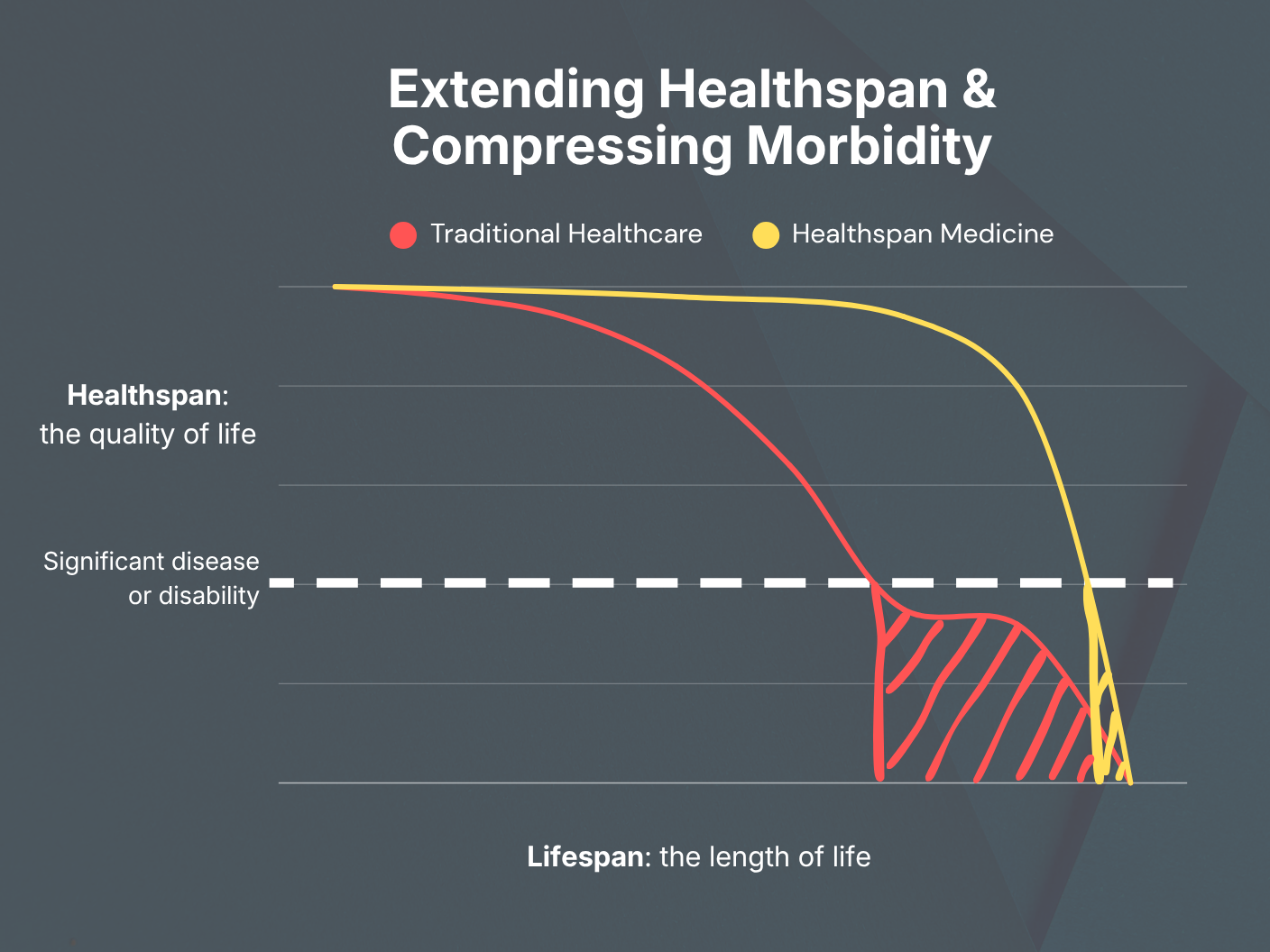
The graph above captures the foundational goal of proactive medicine by plotting functional quality of life against total years lived:
The Vertical Axis (Healthspan): Represents the quality of life and physical, cognitive, and metabolic functional capacity.
The Horizontal Axis (Lifespan): Represents chronological length of life in years.
The Dashed Horizontal Line: Represents the threshold of significant disease or disability—the point where an individual loses functional independence and requires substantial medical or institutional support.
The Red Curve: Traditional Healthcare
The red curve illustrates how standard aging unfolds under conventional, reactive medicine:2
Early, Progressive Erosion: Starting in midlife, physical capacity, metabolic flexibility, and vascular elasticity steadily decline.
Early Threshold Crossing: By age 60 to 70, the curve drops below the dashed line, marking the onset of chronic disease, mobility loss, or cognitive impairment.
The Shaded Red Area (Prolonged Morbidity): The large shaded red section represents a prolonged period of late-life disability. While pharmaceuticals and interventions keep the patient alive, they spend 10 to 15 years living below the independence threshold.1,2
The Yellow Curve: Healthspan Medicine
First formalized by Dr. James Fries in 1980, the compression of morbidity hypothesis aims to "rectangularize" this trajectory:2
Sustained High Function: Functional vitality is maintained at a high level across the vast majority of life.
Delaying the Downward Turn: The onset of chronic illness and physical limitation is pushed as close to the biological end of life as possible.2,3
The Compressed Yellow Window: When decline finally occurs, it is rapid and steep. The shaded yellow area of disability is collapsed into a brief window of months or weeks at the very end of life, rather than entire decades.2
2. The Structural Failure of Reactive Medicine
Why does the conventional healthcare system consistently produce the red curve? Because standard medicine is structurally designed to be reactive rather than proactive.3,4
Standard clinical workflows typically wait for a patient to cross the disability threshold before taking aggressive action:
Waiting for a fasting glucose of 126 mg/dL or an HbA1c of 6.5% before diagnosing diabetes, overlooking years of preceding compensatory hyperinsulinemia.
Waiting for an advanced arterial blockage or an acute heart attack before aggressively lowering atherogenic lipoproteins.
Waiting for a catastrophic fall and hip fracture before addressing progressive muscle loss (sarcopenia) and bone demineralization (osteopenia).
This reactive model manages end-stage organ damage rather than preserving underlying physiological reserves.4 By the time treatments are initiated, substantial tissue architecture has often been permanently lost.
3. The "Reserve Cliff": The Three Pillars of Functional Independence
To prevent an individual from dropping below the disability threshold, clinicians must understand which physiological reserves are eroding beneath the surface:4,5
1. The Cardiorespiratory Reserve
Cardiorespiratory fitness (measured as VO2 max) is one of the strongest independent predictors of all-cause mortality.5
The Rate of Decline: VO2 max does not decline in a flat line. While it drops by roughly 3% to 6% per decade in early adulthood, that decline accelerates past age 70 to more than 20% per decade (or roughly 4 to 5 mL/kg/min per decade in late life).5
The Functional Threshold: Maintaining basic physical independence (such as climbing stairs or carrying groceries) generally requires a functional capacity of around 15 to 18 mL/kg/min.
The Cliff: If an individual enters their 70s with a VO2 max near that functional threshold, a single hospital stay or acute illness can deplete their remaining buffer and push them below the line of independent living.4,5
The Trainability Factor: Cardiorespiratory fitness remains trainable across the lifespan. Clinical trials demonstrate that previously sedentary adults can improve peak VO2 by up to 20% to 25% even into their 80s through structured aerobic training.
2. The Musculoskeletal Reserve
Muscle mass, neuromuscular power, and bone mineral density peak in early adulthood and decline without targeted resistance training.6
Fast-Twitch Fiber Loss: Type II muscle fibers, responsible for rapid force generation and balance recovery, decline disproportionately with age.6
Fall Prevention: A severe fall in an older adult is rarely an unpredictable accident; it is often the physical manifestation of exhausted neuromuscular power and degraded bone architecture.4,6 Maintaining muscle mass and bone density through progressive resistance training creates physical armor that protects against debilitating fractures.
3. The Vascular and Metabolic Reserve
Atherosclerosis and insulin resistance develop silently over 20 to 40 years before causing noticeable symptoms.4
Microvascular Perfusion: Arterial stiffening, subclinical plaque accumulation, and chronic hyperinsulinemia gradually impair microvascular blood flow to the brain and kidneys.3,4
Preserving Organ Function: Managing atherogenic particles (Apolipoprotein B) and maintaining high insulin sensitivity in midlife preserves microvascular perfusion, keeping vital organs resilient against acute physiological stressors.
4. Geromedicine: Targeting Biological Aging as the Root Cause
While standard preventive medicine focuses on individual risk factors like blood pressure and cholesterol, geromedicine expands this approach by targeting the underlying biology of aging itself.3,4
In geromedicine, we recognize that biological aging is the shared root driver connecting multiple age-related chronic conditions:3,4
Cardiovascular Disease
Neurodegenerative Disorders
Malignancies
Type 2 Diabetes and Metabolic Syndrome
Sarcopenia and Physical Frailty
As tissues age, common cellular processes drive systemic functional decline across all organ systems:3,4
Cellular Senescence & Inflammaging: Damaged cells permanently arrest division and secrete pro-inflammatory factors (the SASP) that degrade tissue architecture and stiffen blood vessels.4
Mitochondrial Decay & Nutrient-Sensing Dysregulation: Cellular energy production drops while cells become resistant to insulin signaling, impairing metabolic flexibility.
Loss of Proteostasis: Misfolded proteins accumulate in neural and vascular tissues, accelerating cognitive and microvascular impairment.
By studying and targeting these shared upstream mechanisms, geromedicine aims to delay the onset of multimorbidity—preventing multiple chronic conditions concurrently rather than managing diagnoses in isolation.3,4
5. The Clinical Playbook: How to Shift the Trajectory
Shifting your trajectory from the prolonged disability of the red curve to the compressed morbidity of the yellow curve requires a proactive strategy:2,3
Build and Maintain Surplus Physiological Reserve: Cardiorespiratory fitness and muscle strength act as physiological reserve accounts. Building high peak VO2 max, muscular strength, and bone density early provides a deep reservoir, while ongoing training in later decades helps preserve functional capacity.5,6
Eliminate Silent Vascular Drivers: By identifying and treating elevated Apolipoprotein B (ApoB), subclinical coronary artery calcification (CAC), and borderline hypertension early, clinicians can intercept microvascular ischemia before it causes permanent organ damage.4
Preserve Metabolic Flexibility: Preventing hyperinsulinemia and visceral fat accumulation maintains cellular mitochondrial efficiency and reduces systemic inflammation.3,4
Integrate Geromedicine and Biomarker Tracking: Tracking biological aging markers and evaluating candidate gerotherapeutics allows clinicians to address upstream cellular decline before it manifests as overt disease.3,4
The Bottom Line
Living longer is only a triumph if those added years are defined by physical vitality, mental clarity, and functional independence.1,2
The mission of healthspan medicine and geromedicine is not simply to extend chronological lifespan, but to ensure that your healthspan matches your lifespan—collapsing the period of chronic disease and dependency into the smallest possible fraction of your life.1,2
Explore where candidate aging interventions currently stand on the clinical evidence spectrum with our Gerotherapeutics Dashboard.
Have questions about building physiological reserve, interpreting cardiovascular screening, or personalizing your preventive health strategy? Ask our physicians directly through our Weekly Healthspan Q&A—we answer reader-submitted questions every week in our newsletter.
(Disclosure: The Healthspan Engine, Gerotherapeutics Dashboard, and Weekly Q&A are free educational resources provided by delaeMD.)
References
Garmany A, Terzic A. Global Healthspan-Lifespan Gaps Among 183 World Health Organization Member States. JAMA Network Open. 2024;7(12):e2450241.
Fries JF. Aging, natural death, and the compression of morbidity. The New England Journal of Medicine. 1980;303(3):130-135.
Kennedy BK, Berger SL, Brunet A, et al. Geroscience: linking aging biology to chronic disease. Cell. 2014;159(4):709-713.
Kritchevsky SB, Cummings SR. Geroscience. JAMA. 2025;334(12):1094-1102.
Ross R, Blair SN, Arena R, et al. Importance of Assessing Cardiorespiratory Fitness in Clinical Practice: A Case for Fitness as a Clinical Vital Sign: A Scientific Statement From the American Heart Association. Circulation. 2016;134(24):e653-e699.
Strasser B, Siebert U. Role of strength training in the prevention and treatment of metabolic syndrome: a review. Sports Medicine. 2010;40(10):831-848.
López-Otín C, Blasco MA, Partridge L, Serrano M, Kroemer G. Hallmarks of aging: An expanding universe. Cell. 2023;186(2):243-278.
Clinical Oversight & Authorship
Physician revieweddelaeMD Clinical Team
Clinical content at delaeMD is written and reviewed by licensed physicians, grounded in peer-reviewed evidence and current clinical guidelines, and intended for education — not as a substitute for individualized medical advice. Reviews are non-sponsored, physician-directed, and conducted independently of industry funding.