In discussions surrounding physical longevity, two metrics consistently capture the spotlight: cardiorespiratory fitness (VO2 max) and skeletal muscle mass.
Aerobic capacity and muscle mass are powerful predictors of all-cause mortality, but they represent only part of the physical healthspan equation. You can have strong aerobic endurance and substantial muscle mass, but if your joints lack functional, active range of motion, your ability to translate that fitness into real-world independence becomes severely compromised.
Functional movement capacity is often among the earliest physical domains to quietly decline. It plays a central role in determining whether an individual can navigate daily life without assistance in their later decades.
Here is an evidence-based look at the physiology of joint aging, what compromised movement capacity looks like, what clinical outcome studies reveal about functional performance and survival, and how to build a sustainable movement practice at any age.
1. Flexibility vs. Active Range of Motion: A Practical Framework
In everyday fitness discussions, flexibility and mobility are often used interchangeably, but exercise physiologists and movement specialists view them through distinct lenses:
Flexibility (Passive Extensibility): The capacity of a muscle and connective tissue to lengthen passively when an external force is applied (such as holding a hamstring stretch with a strap).
Active Range of Motion (Mobility): The ability of a joint to move actively through its anatomical workspace under your own muscular strength and neuromuscular control.
Passive tissue extensibility without active motor control has limited value in daily life.
Full functional range of motion relies on an interplay between tissue compliance, joint capsule health, and active end-range neuromuscular strength. When a joint lacks active strength and stability at the outer limits of its range, the central nervous system often restricts movement to protect the joint, leading to altered movement patterns.
2. What Loss of Movement Capacity Looks Like in Daily Life
The loss of functional joint range is typically a gradual adaptation to repetitive daily postures and sedentary habits. Over decades, joint capsules tighten, connective tissues experience cross-linking, and synovial fluid circulation within the joint space decreases.
In older age, restricted joint movement shows up in fundamental daily activities:
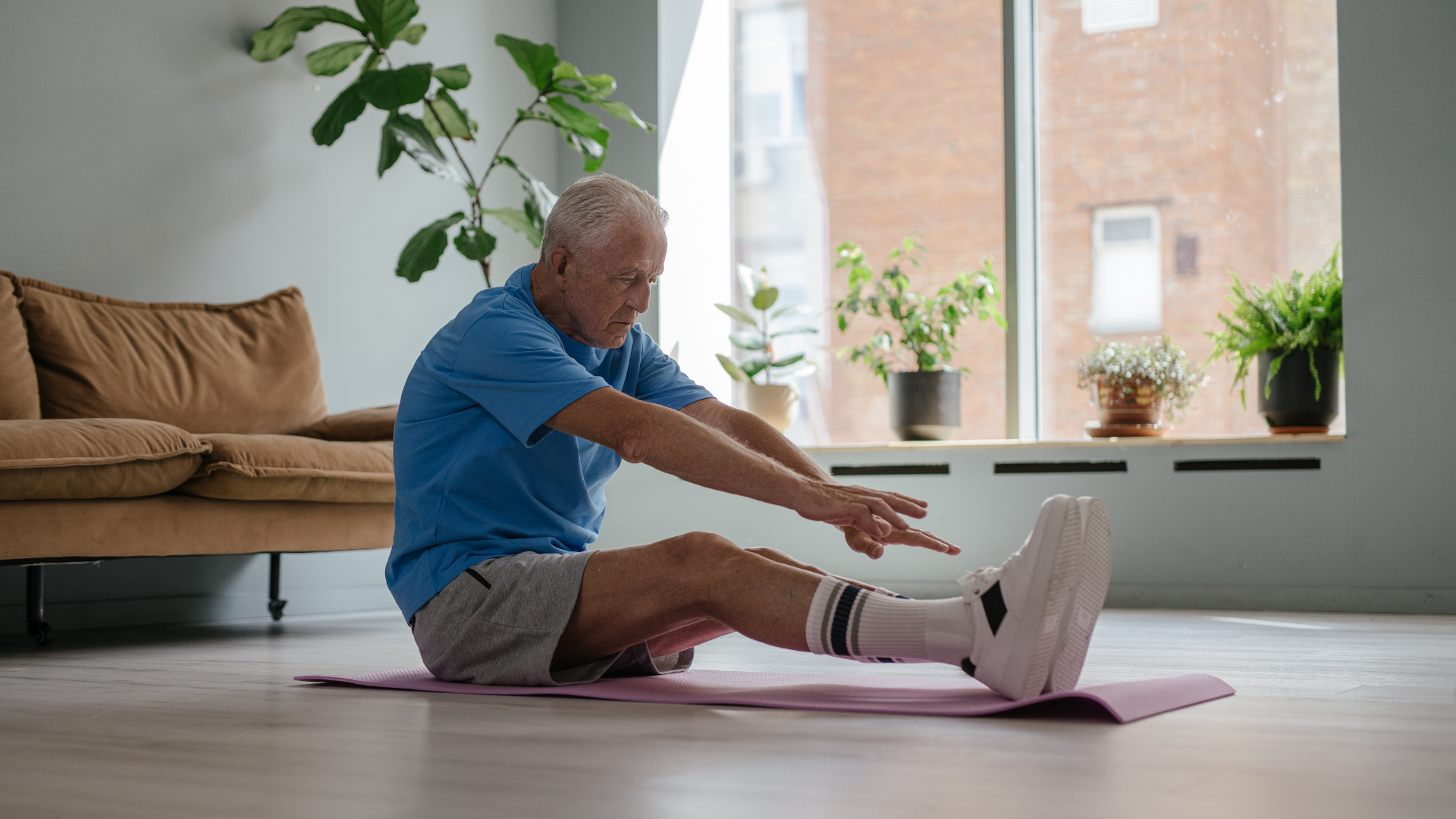
Difficulty Getting Up from the Floor: Losing hip rotation, ankle dorsiflexion, and spinal extension makes rising from the ground without relying on furniture or hands significantly more difficult.
Loss of Routine Self-Care: Decreased shoulder rotation and thoracic mobility turn simple tasks—like reaching for an overhead object, fastening clothing, or reaching behind to buckle a seatbelt—into frustrating challenges.
Gait Alterations: Stiff ankles and limited hip extension often lead to a shorter, shuffling stride, reducing the foot's ability to clear small ground obstacles.
Biomechanical Load Shifts: When primary mobile segments (such as the hips, thoracic spine, and ankles) lose their natural excursion, neighboring areas (such as the lumbar spine and knees) are often forced to take on extra mechanical stress during basic movements.
3. What the Clinical Evidence Shows
The relationship between functional movement, physical capacity, and long-term health outcomes is supported by extensive clinical literature.
The Sitting-Rising Test and Mortality Risk
One of the most compelling demonstrations of functional movement as a clinical vital sign comes from the Sitting-Rising Test (SRT), pioneered by Dr. Claudio Gil Araújo and colleagues.1
The assessment evaluates an individual's ability to sit down on the floor and stand back up with minimal reliance on hands, knees, or arms, scored on a scale from 0 to 10:
In the initial prospective study of 2,002 adults aged 51 to 80 published in the European Journal of Preventive Cardiology, participants with the lowest scores (0 to 3 points) had a 5 to 6 times higher risk of all-cause mortality over a 6-year follow-up compared to those with high scores (8 to 10 points).1
Each 1-point improvement in the SRT score was associated with a 21% reduction in all-cause mortality.1
A larger follow-up cohort of over 4,200 adults followed for a median of 12.3 years confirmed that lower SRT scores were strongly associated with higher rates of both natural and cardiovascular mortality.2
The Sitting-Rising Test is not a measure of pure cardiovascular endurance; it is a composite assessment of hip and ankle range of motion, core stability, balance, and relative neuromuscular strength.
Preventing Mobility Disability: The LIFE Study
The landmark Lifestyle Interventions and Independence for Elders (LIFE) Study, published in JAMA, evaluated over 1,630 sedentary older adults at high risk for physical decline.3
The randomized trial demonstrated that a structured physical activity program—combining moderate-intensity walking with resistance training, balance exercises, and flexibility work—significantly reduced the incidence of major mobility disability (the inability to walk 400 meters) by roughly 18% over 2.6 years compared to health education alone.3
Multisite joint stiffness has also been shown in longitudinal studies to independently predict new and worsening disability in older adults.4 Maintaining movement capacity protects against the downward spiral of deconditioning: when movement becomes uncomfortable or restricted, overall physical activity drops, accelerating the loss of muscle mass, bone density, and metabolic fitness.
4. When Should You Start? An Age-Phased Approach
Because joint tissues adapt to the positions they occupy most frequently, maintaining movement capacity is a lifelong endeavor:
In Your 20s and 30s: Focus on offset training. Prolonged sitting and repetitive athletic patterns (such as running purely in a single plane) can create early postural stiffness. Regular movement through full ranges of motion preserves baseline joint health and tissue compliance.
In Your 40s and 50s: Prioritize joint workspace and rotational capacity. This is the window where connective tissues naturally lose elasticity. Maintaining active hip rotation, thoracic extension, and ankle dorsiflexion helps preserve efficient mechanics under load.
In Your 60s and Beyond: Focus on functional autonomy, balance, and floor-to-standing transitions. Regular multi-planar movement directly supports your ability to navigate uneven ground, maintain equilibrium, and recover from unexpected stumbles.
5. Four High-Yield Movement Exercises for Joint Function
You do not need a complex routine to support joint health. Consistently practicing a few fundamental movements that explore end-range positions provides valuable neuromuscular and articular stimulus.
These four exercises can be integrated into a broader physical training routine:
1. Controlled Articular Rotations (CARs) for Hips and Shoulders: Move the joint slowly through its outer active perimeter without allowing the torso to twist. This reinforces active motor control at end-ranges while circulating synovial fluid across the joint surface.
2. The 90/90 Hip Position: Sit on the floor with your front leg bent at 90 degrees (external rotation) and your back leg bent at 90 degrees to the side (internal rotation). Practice sitting tall and gently transitioning between sides. This targets the deep hip rotators essential for walking mechanics and floor transitions.
3. Thoracic Spine Rotations (Quadruped or Side-Lying): While kneeling or lying on your side, rotate your rib cage and upper back while keeping your hips and lower back steady. Maintaining thoracic rotation reduces excessive twisting demands on the lumbar spine.
4. Assisted Deep Squat Hold: Lower into a deep squat, holding onto a secure surface or doorframe for balance if needed. Spend 1 to 2 minutes gently driving the knees forward over the toes to challenge ankle dorsiflexion and open the hips.
Cardiorespiratory fitness and muscle strength provide the power for a long life, but functional joint range of motion provides the foundation for using that strength in daily life.1,3
Integrating active movement training alongside aerobic exercise and resistance training helps ensure that the years you add to your life remain active, capable, and physically independent.
References
Brito LB, Ricardo DR, Araújo DS, et al. Ability to sit and rise from the floor as a predictor of all-cause mortality in middle-aged and older adults. European Journal of Preventive Cardiology. 2014;21(7):892-898.
Araújo CGS, de Souza E Silva CG, Myers J, et al. Sitting-Rising Test scores predict natural and cardiovascular causes of deaths in middle-aged and older men and women. European Journal of Preventive Cardiology. 2025;zwaf325.
Pahor M, Guralnik JM, Ambrosius WT, et al. Effect of structured physical activity on prevention of major mobility disability in older adults: the LIFE randomized clinical trial. JAMA. 2014;311(23):2387-2396.
Thakral M, Shi L, Shmerling RH, et al. A stiff price to pay: does joint stiffness predict disability in an older population?. Journal of the American Geriatrics Society. 2014;62(10):1891-1899.

Noah Mehr, MD
Physician reviewedPhysician & Co-Founder
Clinical content at delaeMD is written and reviewed by licensed physicians, grounded in peer-reviewed evidence and current clinical guidelines, and intended for education — not as a substitute for individualized medical advice. Reviews are non-sponsored, physician-directed, and conducted independently of industry funding.
Physician Dispatch
The Clinical Dispatch
Physician-authored articles on healthspan and preventive medicine. With Michael Leone, MD.