

Modern healthcare has achieved extraordinary triumphs: emergency interventions, trauma surgery, and acute pharmaceuticals allow humans to live longer than at any point in history. However, extended lifespan has not automatically translated into extended healthspan—the years of life spent in vibrant, functional health free from debilitating chronic disease.
Closing this gap requires an evolution in how we deliver medical care. While board-certified Preventive Medicine and Lifestyle Medicine have laid vital groundwork in disease prevention, the reality of today's clinical system is that traditional primary care is rarely structured, funded, or timed to deliver deep, continuous proactive care.
Here is why our healthcare system needs a dedicated, standardized focus on Healthspan Medicine—and how a dedicated clinical partner can transform long-term health trajectories.
1. Primary Care Physicians Are Trapped in a Reactive System
To understand why proactive health care often falls through the cracks, one must look at the constraints of modern primary care. Primary care physicians (PCPs) are among the most dedicated professionals in medicine, but they are trapped in a high-volume system built for reactive care.
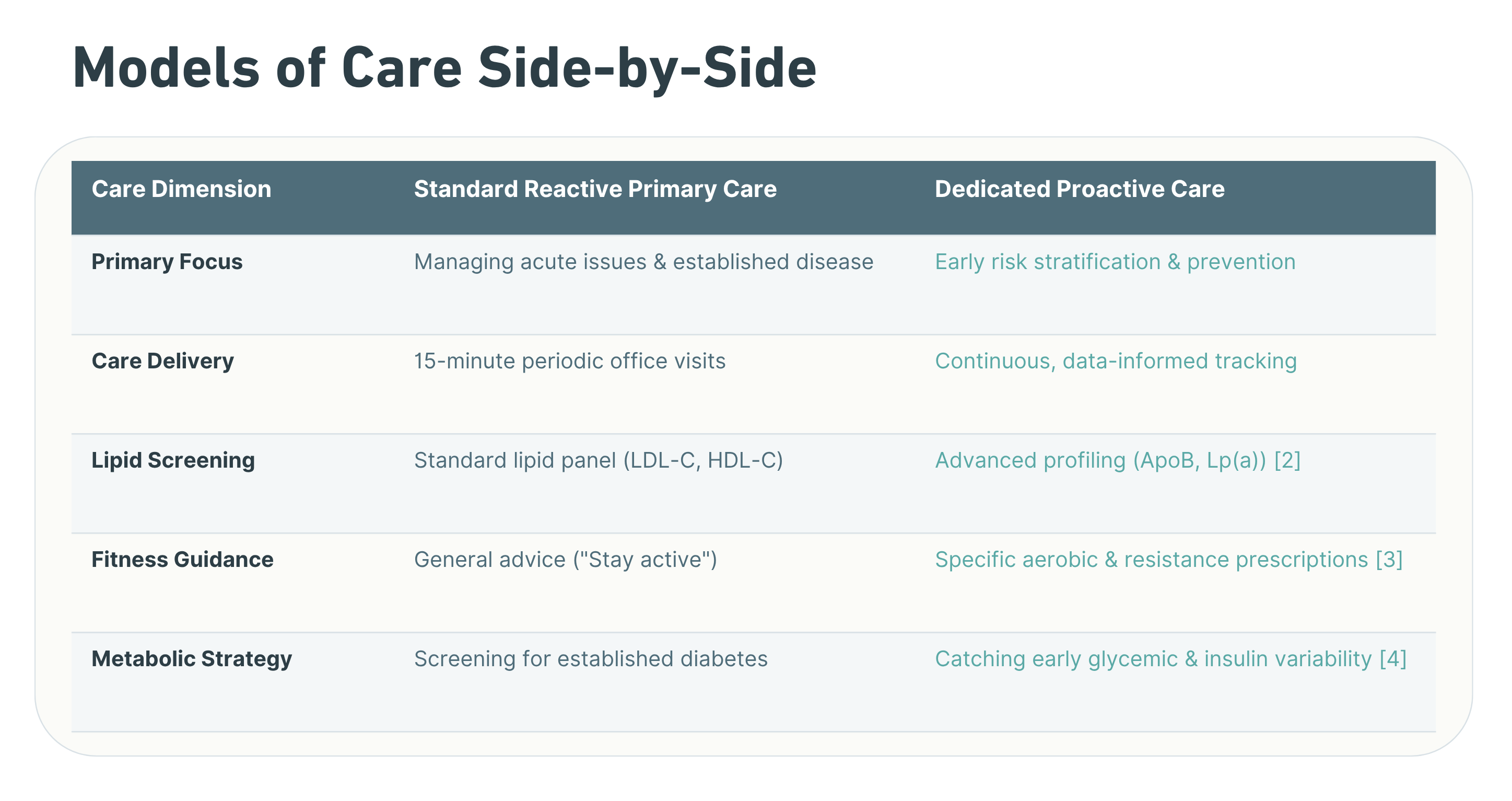
The 15-Minute Assembly Line: The average primary care visit lasts between 10 and 15 minutes [1]. In that window, a physician must address acute symptoms, reconcile medications, order routine screenings, and complete extensive electronic documentation [1].
Reaction Over Prevention: Insurance models reimburse doctors for treating established disease, not for devoting hours to long-term risk reduction. A PCP is reimbursed for managing established Type 2 diabetes or post-stroke care; they are rarely compensated for conducting detailed exercise capacity evaluations, evaluating continuous glycemic trends, or optimizing advanced lipid subfractions decades in advance.
Administrative Burden: PCPs spend nearly two hours on administrative work for every hour of direct patient contact [1]. Expecting generalists to manage complex, continuous proactive health protocols for panels of 2,000+ patients is structurally impossible.
2. Bridging General Primary Care and Specialized Prevention
Proactive health care has moved far beyond basic advice to "eat well and exercise." Modern geroscience, preventive cardiology, and metabolic health have generated a massive volume of clinical research that builds upon established preventive standards:
Advanced Lipidology: Expanding beyond basic LDL-C panels to assess Apolipoprotein B (ApoB) and Lipoprotein(a) for more precise cardiovascular risk stratification [2].
Exercise Physiology: Evaluating cardiorespiratory fitness (VO2 max) as a fundamental vital sign and prescribing specific aerobic and strength thresholds [3].
Targeted Metabolic Diagnostics: Utilizing continuous monitoring tools and advanced biomarkers selectively to identify insulin resistance long before standard screening detects diabetes [4].
While fields like Preventive Medicine and Lifestyle Medicine established these principles conceptually, busy general primary care clinics rarely have the time or bandwidth to integrate continuous tracking and detailed lifestyle prescriptions into daily practice. A dedicated healthspan focus bridges this gap.
3. Bringing Standardization to an Unregulated Market
Because traditional medicine has been slow to offer high-touch proactive care, the private wellness market has rushed in to fill the void. Without clinical standardization, however, the "longevity" space has faced significant commercial noise.
In many direct-to-consumer longevity clinics, unvalidated trends are routinely sold without clinical rigor:
Sourcing unregulated, unapproved peptide compounds lacking human safety data.
Ordering broad imaging for average-risk individuals without pre-scan risk profiling.
Recommending high-cost IV vitamin drips for patients without diagnosed deficiencies.
Using commercial "biological age" clocks to sell proprietary supplement lines.
Establishing clear clinical standards for Healthspan Medicine brings evidence-based rigor to proactive care, distinguishing proven cardiovascular, metabolic, and exercise interventions from unvalidated marketing trends.
4. What a Dedicated Healthspan Partner Provides
A physician focused on healthspan does not replace a primary care doctor for acute illnesses, urgent care, or routine subspecialty referrals. Instead, they serve as a dedicated clinical partner focused entirely on long-term health trajectory and functional capacity.
Rather than waiting for diagnostic thresholds to be crossed, a healthspan-focused practice:
Establishes a Personalized Risk Profile: Combines advanced cardiovascular markers (ApoB, Lp(a)), metabolic testing, and functional physical metrics to identify hidden risks early [2,3].
Applies Evidence-Based Interventions: Prescribes validated pharmacotherapy (such as lipid-lowering agents or metabolic regulators) alongside structured lifestyle interventions when clinical data shows clear net benefit [2].
Utilizes Targeted Remote Monitoring: Integrates home vitals, wearables, and continuous tracking tools where appropriate to establish true personal baselines rather than relying on a single annual data point [4].
Provides Long-Term Clinical Accountability: Delivers ongoing physician guidance to ensure lifestyle and medical interventions produce measurable, durable improvements in cognitive and physical performance.
Addressing the Access and Equity Challenge
A common criticism of proactive health care is that high-touch, continuous care often lives in cash-pay, concierge models accessible primarily to affluent patients.
This is precisely why formalizing proactive health care within clinical medicine is so critical. By building robust clinical trial data, establishing standardized practice guidelines, and demonstrating that early prevention reduces long-term healthcare costs, we create the blueprint needed to make proactive healthspan care reimbursable and accessible across the broader healthcare system.
The Bottom Line
Protecting your future healthspan—optimizing cardiovascular function, preserving muscle strength, and preventing metabolic decline—requires time, specialized tracking, and a dedicated strategy.
The shift toward proactive Healthspan Medicine is an essential evolution in modern care. Everyone deserves access to a physician whose mission extends beyond treating illness after it appears—focusing explicitly on keeping you healthy, strong, and performing at your best for decades to come.
References
Sinsky C, Colligan L, Li L, et al. Allocation of Physician Time in Primary Care Office Practice: An Observational Study in 4 Specialties. Annals of Internal Medicine. 2016;165(11):753-760.
Grundy SM, Stone NJ, Bailey AL, et al. 2018 AHA/ACC/AACVPR/AAPA/ABC/ACPM/ADA/AGS/APhA/ASPC/NLA/PCNA Guideline on the Management of Blood Cholesterol: A Report of the American College of Cardiology/American Heart Association Task Force on Clinical Practice Guidelines. Circulation. 2019;139(25):e1082-e1143.
Ross R, Blair SN, Arena R, et al. Importance of Assessing Cardiorespiratory Fitness in Clinical Practice: A Case for Fitness as a Clinical Vital Sign: A Scientific Statement From the American Heart Association. Circulation. 2016;134(24):e653-e699.
Waalen J. Mobile Health and Preventive Medicine. The Medical Clinics of North America. 2023;107(6):1097-1108.
Editorial Oversight & Clinical Review
delaeMD Clinical Team
Clinical content at delaeMD is written and reviewed by licensed physicians. Articles are grounded in peer-reviewed evidence and current clinical guidelines, and are intended for education — not as a substitute for individualized medical advice.